The Man Who Cycled the World
Mark Beaumont
Bantam Press 2009
419 pages
"After only 10km, I was exhausted. My legs were fresh but my head dropped and my eyelids started slow-blinking. The surge of adrenalin at the start had passed, and I felt shattered. The last few weeks had been a series of ridiculous and unsustainable routines that had left me completely void of energy at the outset of my 18,000 mile cycle."
So begins the tale of Mark Beaumont, a Scottish adventurist who has decided to break the Guinness World record of cycling the world which at the time stood at 276 days. As Mr. Beaumont explains "...I would have to cycle 18,000 miles, start and finish in the same place, go in one direction, and pass through two points on opposite sides of the world, among other criteria" (which included using the same bike).
Making the story even more interesting is the fact that the author has never been obsessed with cycling. His younger passions included horseback riding and skiing. It is never satisfactorily explained why he chose this particular epic and novel journey and it should be pointed out that this bike trip is a race. Which means the author never has much opportunity to stay for very long in any one place.
With his head down and eyes focused on the route in front of him, the reader never gets the impression of reading a travel book by the likes of Bill Bryson or Paul Theroux. Like Theroux portions are a repetitive litany of stats: "90m ascent, 179km, 32 degrees. 7.30 start, 8 and a half hours cycling in 11 hours and 5 mins...Really tough day. So low on energy and left calf really sore. Shit lunch and breakfast. Shouted at police escort."
At 419 pages, the book does offer a nice long, winter read, curled up in your favourite spot and dreaming of cycling adventures of your own. Cycling around the world is a remarkable achievement and for those who have made long distance cycling trips, Mr. Beaumont's journey will astound you and you will be left shaking your head in amazement that he did in fact break the Guinness World record.
Stories and helpful tips about bikes and biking - including bicycle tours, bicycle camping, bicycle repairs among others.
Wednesday, November 16, 2011
Friday, November 11, 2011
Lock It or Lose It
![]() |
| Dig it |
To save weight when we're bicycle camping, I use a seven foot length of aircraft cable which I have looped at either end and then fasten the cable with a light lock. My idea being that this method, if nothing else will slow down the perps. I go so far as to hide a bear bell amongst the cable and bikes so that no matter how quiet the creeps are if they try to steal from us, the bell will ring and alert us to the potential calamity.
| Cable from Home Despot |
Even in my garage, I lock my bikes up using this same cable to thwart an opportunistic thief who might dash into the garage while we are working around the yard. Again, it will slow the jerk down and give pause to trying to steal one of my bikes.
| Two potential winter bikes locked up in the garage |
As much as my cycle camping friends scoff at the idea of locking the bikes out in the woods, I notice that they make no fuss when, after all the gear has been removed, I suggest that it is time to lock up the bikes as it is getting dark and becoming difficult to see fine work.
Tuesday, November 8, 2011
Studly Do-Right
As the days shorten, it is only a matter of time before the snow flies and ice begins to form on our streets which means it is time to stud a pair of tires to use on this winter's commutes. And you'll find that with a minimum of mechanical expertise, it is easy to do.
The first step is to use a pair of knobby tires - the bigger the knobs the better. Using a drill, you'll want to screw 5/8"sheet metal screws into the inside of the tire. With a bit of luck, you'll end up placing the screw right into the center of one of the knobs. 50 screws per tire will do the job.
Alternate the knobs that you put the screws into otherwise you'll find that your tire will go bump,bump,bump as you ride. The ends of the screws are very sharp so handle the tires carefully. Through riding on pavement, the screws will eventually wear down to a smaller size and lose some of their sharpness. Don't worry - that wearing down won't affect their performance.
Next: Part Two - Lining the tire and mounting
| The knobbier the better |
The first step is to use a pair of knobby tires - the bigger the knobs the better. Using a drill, you'll want to screw 5/8"sheet metal screws into the inside of the tire. With a bit of luck, you'll end up placing the screw right into the center of one of the knobs. 50 screws per tire will do the job.
| With self-tapping screws, drilling is easy |
Alternate the knobs that you put the screws into otherwise you'll find that your tire will go bump,bump,bump as you ride. The ends of the screws are very sharp so handle the tires carefully. Through riding on pavement, the screws will eventually wear down to a smaller size and lose some of their sharpness. Don't worry - that wearing down won't affect their performance.
| You can also use 1/2" screws |
Saturday, November 5, 2011
Where Is That Stuff?
| "Furry Lewis" stripped down for MTB'ing |
What complicates things is having five bikes, two different sets of panniers, three pairs of cycling shorts, three bike tools, two compressed air inflaters, two pairs of short fingered bike gloves, one neck tube, one balaclava and...
Add to that the fact that most of the bikes are configured differently. Two mountain bikes (the MOAB and Furry Lewis) have pannier racks, but the road bike (Mississippi 'Red) and the folding bike (Foldey Hawn) don't have any kind of rack. The 1963 Triumph and the tandem both have a rack on the back but the panniers don't fit them.
So it easy to understand how I can be stumbling around the house in the morning dark trying to find my helmet cover or my winter mitts to put over my cycling gloves. I will have already looked at the outside temperature station to determine what I need to wear and if it is cold enough, I will begin my search for missing items.
I tell myself that when I get home from work, first thing I'll do is organize my stuff for the morrow but then I discover that my daughter and her boyfriend are staying for dinner and nothing has been started. My own hunger from my commute will propel me into the kitchen where I'll be grabbing vegetables and trying to find the rice since our guests are vegetarians. While I'm cooking, I tell myself that after supper I'll gather everything together but after dinner Roy calls and we spend the rest of the evening planning next year's bicycle camping trip and then...
Tuesday, November 1, 2011
Critical Miss
Maybe it was the near zero temperatures that kept most cyclists away, but when I showed up at Silly Hall there were only six other hardy cyclists there waiting for more people to show up to do the "Critical Mass".
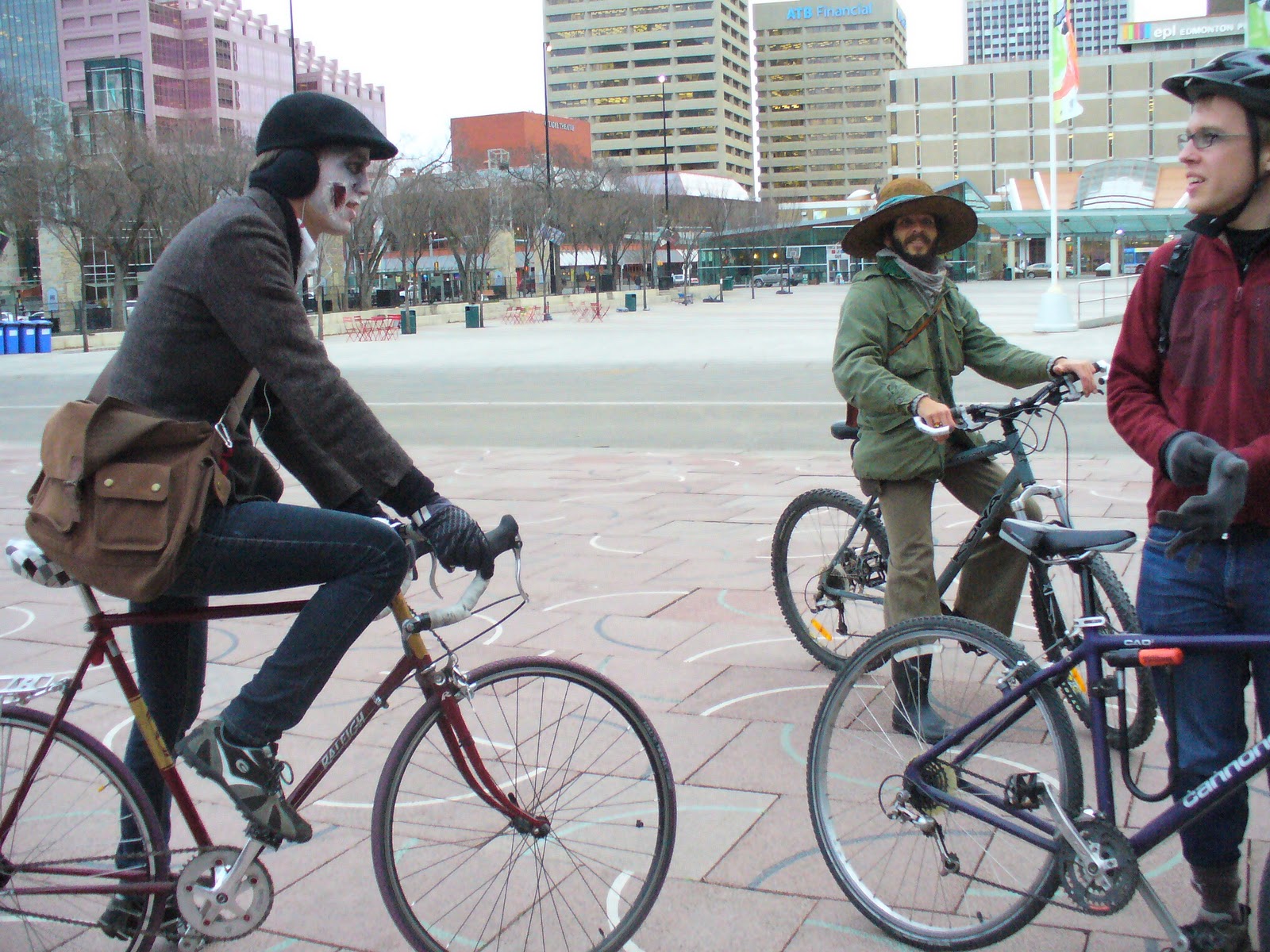
Forgetting it was Halloween time, I was unprepared for some of the riders wearing costumes. One guy (see photo) had Zombie makeup and his friend Steve had blackened his eyes (or maybe he'd been in an altercation) and Lee, who had recently ridden his bike here from NYC, shrugged on a clown suit that he had purchased for five bucks at Villue Vallage.
My experience in the past on these rides has been to ride near the front. Reason being that if you ride right in the front, you have to make important decisions that affect everyone especially those riding in the rear. Do we go through this red light? Can we all make this advanced green? When is the best time to change lanes so that it is safe for everyone?
If you ride in the very rear, then you might have to tolerate impatient drivers who are honking their horns or provocatively driving close to your rear tire. As far as I'm concerned the best spot is close to the front where you can easily follow their lead. If they decide to turn left on a yellow, you can put the pedal to the metal and charge after them. If they suddenly decide to stop, then you can brake as well.
As we rode along Jasper Avenue, I reflected on something my friend Anne had mentioned about her last Critical Mass ride. As she had pointed out, it is liberating to ride at a leisurely pace on a major traffic artery. Waving to pedestrians rushing home from work, ringing our bells at the "Occupy" occupiers who shouted encouragement to us as we cycled past their camp. It has been a long two years since I have ridden with this group and I found it to be quite novel experience.
A quick vote was taken at the red light at 109 Street and we all decided to take the western lane of the High Level Bridge. By the time we had reached that trestled structure, we were fifteen riders strong and had a terrific ride across the bridge. I had to pinch myself to make sure I wasn't dreaming. When do you ever get to cross the High Level except by motorized transportation?
Riding down Whyte Ave elicited many hoots and whoo yoos from costumed revellers already into the Halloween spirit(s). I found myself in the rear somehow and rationalized that it was important to ride in every position in the pack.
Before I spun away to head off to work, I enjoyed watching a black bearded, long haired clown holding up traffic and signalling us to make the left turn toward Gazebo Park. That sight made my Halloween for me.
Forgetting it was Halloween time, I was unprepared for some of the riders wearing costumes. One guy (see photo) had Zombie makeup and his friend Steve had blackened his eyes (or maybe he'd been in an altercation) and Lee, who had recently ridden his bike here from NYC, shrugged on a clown suit that he had purchased for five bucks at Villue Vallage.
| Mr. Zombie,Mr.South America and Steve with 2 black eyes |
My experience in the past on these rides has been to ride near the front. Reason being that if you ride right in the front, you have to make important decisions that affect everyone especially those riding in the rear. Do we go through this red light? Can we all make this advanced green? When is the best time to change lanes so that it is safe for everyone?
If you ride in the very rear, then you might have to tolerate impatient drivers who are honking their horns or provocatively driving close to your rear tire. As far as I'm concerned the best spot is close to the front where you can easily follow their lead. If they decide to turn left on a yellow, you can put the pedal to the metal and charge after them. If they suddenly decide to stop, then you can brake as well.
As we rode along Jasper Avenue, I reflected on something my friend Anne had mentioned about her last Critical Mass ride. As she had pointed out, it is liberating to ride at a leisurely pace on a major traffic artery. Waving to pedestrians rushing home from work, ringing our bells at the "Occupy" occupiers who shouted encouragement to us as we cycled past their camp. It has been a long two years since I have ridden with this group and I found it to be quite novel experience.
![]() |
| Wowzers! |
A quick vote was taken at the red light at 109 Street and we all decided to take the western lane of the High Level Bridge. By the time we had reached that trestled structure, we were fifteen riders strong and had a terrific ride across the bridge. I had to pinch myself to make sure I wasn't dreaming. When do you ever get to cross the High Level except by motorized transportation?
Riding down Whyte Ave elicited many hoots and whoo yoos from costumed revellers already into the Halloween spirit(s). I found myself in the rear somehow and rationalized that it was important to ride in every position in the pack.
Before I spun away to head off to work, I enjoyed watching a black bearded, long haired clown holding up traffic and signalling us to make the left turn toward Gazebo Park. That sight made my Halloween for me.
Friday, October 28, 2011
Spokeconfusion
In an effort to learn as much as I can about repairing bikes, I signed up for a wheel building course at "Bikeworks". Gathered around me were seven other enthusiasts who seemed to grasp the very complicated instructions necessary to determine what parts are needed to build a wheel.
Oh sure, I was okay at the beginning of the class when it came to asking questions like "In this example you're passing around, why is one nipple bigger than the other?" Or "The longer it gets - the harder it gets?" - spokes that is. But when our fine instructor Axel got down to the nitty-gritty of "SPOKE CALCULATION" that's when my eyes began to glaze over and I knew then that I shouldn't have dropped math as soon as I could in high school (grade eleven for those of you who care).
I looked around at the twenty-somethings and they were all nodding in understanding (except for the guy next to me who had fallen asleep and was snoring gently). My friends Rob, Alex and Coreen were asking intelligent questions and making clever observations while I stared at my notebook and tried to make sense of my nearly illegible scrawl: on rims with a deep V-cross section, using hexagonal nipples, tensioning up to 2,000N can be carried out
Or this doozie: fewer spokes reduce weight and improve aerodynamic properties, but need to be given a higher tension, which on the other hand, require more, stable, and thus
heavier rims....
Glancing at my notes again, I couldn't fathom what I had written only moments before:
NTN=581(2)
(2)N-14.8X=29
595X2
600.6
I'm so glad that Alex and Coreen were there to help my class partner Rob and I to do the actual spoke calculation for the wheels we were going to build. In fact, the two of them seemd so non-plussed that I'm confident that with them at my side at next week's class I might just be able to build a wheel that won't collapse the moment someone climbs onto the bike that has my hand-made wheels.
Tuesday, October 25, 2011
Bits and Pieces
As you are riding your bike you see them everywhere. On the side of the road. Wedged underneath a hedge. Carelessly tossed to the curb. Lying on a sidewalk.
I'm talking about the many pieces of flotsam and jetsam that we see everyday yet ignore to such a degree that they hardly register in our minds. This season (from last snow melt to first snowfall) I decided to pick up these various items and see what sort of collection I would have at the end.
For the most part, the hardhat and tools came from a training session for the MS Tour (see "It's a Goldmine!" - June 7th post). The two toned golf shoe I picked up on a rainy ride down to the south side of the city to meet my wife for dinner. The blue plastic pedometer I found on swanky Ada Boulevard (see "The Flowers That Bloom in the Spring Tra-La" - May1st. post). The peep-show SEX coin was discovered on a Saturday ride downtown - not far from the seedy part of the downtown core.
The creepy doll's head escapes my memory but the pink plastic monkey I distinctly recall finding in the sandy dirt at the overnight campsite that Perry and I chose in preparation for the Kettle Valley Railway (see "That Wasn't So Bad" - July 18th post). The boxcutter was near a bus stop not far from my house and the dog tag I found at Terwilligar Park on one of the Fridays I took off so I could train for the MS Mountain Tour (see "Running of the Bulls" - August 26th post).
I suspect that this inclination I have to pick things up and bring them home stems from my misguided youth when I used to bring home (to my parents chagrin) all manner of junk that I had found. The worst was finding a downed aircraft from WW2 while on a church camp hike and carting home a suitcase full of airplane parts. Come to think of it - I still have a couple of pieces that I found at that camp. If I could have found a way to strap a longboard skateboard that I found recently to my pannier rack, I'd have that to show you.
Subscribe to:
Posts (Atom)